


The problem play is a form of drama that emerged during the 19th century as part of the wider movement of realism in the arts. As the term ‘Problem Play’ itself denotes it deals with contentious social issues to expose social ills, and to stimulate thought and discussion on the part of the audience. (Problems) through debates between the characters on stage, who typically represent conflicting points of view within a realistic social context. It is also known as the Drama of Ideas or the realistic drama and this form of drama is the result of growth of scientific spirit as it put emphasis on facts and dispassionate observation of certain issues. The problem plays are somewhat simplistic, didactic thesis plays on subjects such as prostitution, business ethics, illegitimacy, and female emancipation.
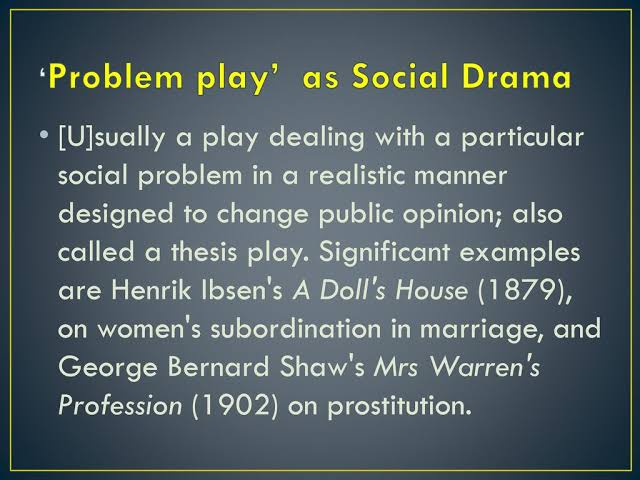
There were certain reasons which contributed to the emergence of these problem plays like rapid advancement of industrialization, science and psychology began to dominate all aspects of life and literature, fading impact of religion on human life, dominance of reason over sentiments. The play writers now dealt with contemporary situations and problems in their plays.
For the first time the social significance of theatre was realised as realism became the outstanding characteristic of British drama. Now dramatists began to write with a purpose to expose the hypocrisy on which our social and family relationships are based.
The Norwegian playwright, Henrik Ibsen gave a new height to this genre whose works had artistic merit as well as topical relevance. His first experiment in the genre was Love’s Comedy (published 1862), a critical study of contemporary marriage. He went on to expose the hypocrisy, greed, and hidden corruption of his society in a number of masterly plays: A Doll’s House, Ghosts, The Wild Duck, An Enemy of the People. His plays ubecame very popular in England and paved the way for the rise of the problem play.

The problem play was introduced into England towards the end of the nineteenth century by Henry Arthur Jones (1851-1929) and Sir A. W. Pinero (1855-1934). These playwrights were influenced by Ibsen but in dramatic talent were not even a patch on him.
In England, George Bernard Shaw brought the problem play to its intellectual peak, both with his plays and with their long and witty prefaces. With all his amazing originality he was highly indebted to Ibsen. In fact his adulatory book on Ibsen The Quintessence of lbsenism (1891) was published a year before the appearance of his own first play Widowers’ Houses the first of the long series of problem plays written by him over the length of more than forty years.

GB Shaw started writing plays to demonstrate that problem plays of the type that Ibsen was writing could succeed on the stage. His plays are full of witty and intellectual discussions of problems in fine and crisp dialogues but having a little action. He was the creator of the drama of ideas. In his famous plays – Widower’s House, To True to be Good, Back to Methuselah, Could, Arms and the Man, Man and Superman he dealt with social problems and in a realistic manner exposed social evils and vices.
Shaw’s contemporary, John Galsworthy also wrote problem plays in the jeast of a social reformer. His first play The Silver Box exposes the pernicious problem of class distinction between the rich and the poor. Strife deals with the conflict between Labour and Capital. Justice highlighted the events in the administration of justice mismanagement in the prisons of England and the cruelty of solitary confinement. The Skin Game deals with the different values of the old aristocracy and the new literature business class.
Another important name in problem play writers is Harley Granville Barker who carried the pursuit of naturalism and realism further than any of his predecessors and his plays come closer to ordinary day to day existence, with the futility of which he is much concerned. His plays are discussions of contemporary problems and his themes include the marriage conventions, inheritance of tainted money, sex and the position of women. Among new plays produced at the Court Theatre were several of his own: The Voysey Inheritance (1905), the most famous, showing Shaw’s influence; Prunella (1906), a charming fantasy written with Laurence Housman; Waste (1907); and The Madras House (1910).
Dr Nemika (Assistant Professor). Department of English. Dayanand Arya Kanya Degree College, Moradabad

